
T-Mobile/Sprint NAD (Chapter 14)

If you need an example to illustrate the work of the National Advertising Division (NAD), here is an excellent example. At the prompting of T-Mobile, the NAD reviewed some of Sprint’s advertising and recommended Sprint modify some its claims, such as “faster data speeds” and “better call quality” to clearly disclose the basis of its comparisons. The NAD recommended Sprint drop other terms, such as “all-new.”

Discussion Questions:

  1. From the Advertising Age article, what phrases or claims did the NAD say Sprint should drop and what claims need to be substantiated?
  2. Why do you think the NAD made these recommendations?
  3. Since the NAD is an industry regulatory agency and has no legal power, why would Sprint comply with the recommendation?
  4. Why do you think T-Mobile asked the NAD to review Sprint’s ads?
  5. After reviewing this case, do you think it is good that the advertising industry has the NAD? Why or why not?
Is Social Media all Talk (Chapter 9)

This article in the Harvard Business Review sparked my interest about social media, especially as brands shift more dollars to social media marketing.  He raises the issue about social media being too much about talk, tweets, and posts, and not enough about the bottom line – does it increase sales?

Discussion Questions:

  1. After reading the article, would you agree with Frank Cespedes that companies do not actually measure social media’s impact on profits? Why or why not?
  2. What are the typical ways companies measure social media impact? Are these good measures? Why or why not?
  3. Cite from the article some of the statistics on social media usage by consumers, such as posts from top brands on Twitter and Facebook reach just 2% of followers. Comment on these statistics.
  4. What is the most surprising fact you picked up from this article? Why is it so surprising?
  5. If you were the marketing manager for a popular brand, what would be your reaction to this article? Explain.

Super Bowl Winners 2015, Part 4 (Chapters 7 & 9)

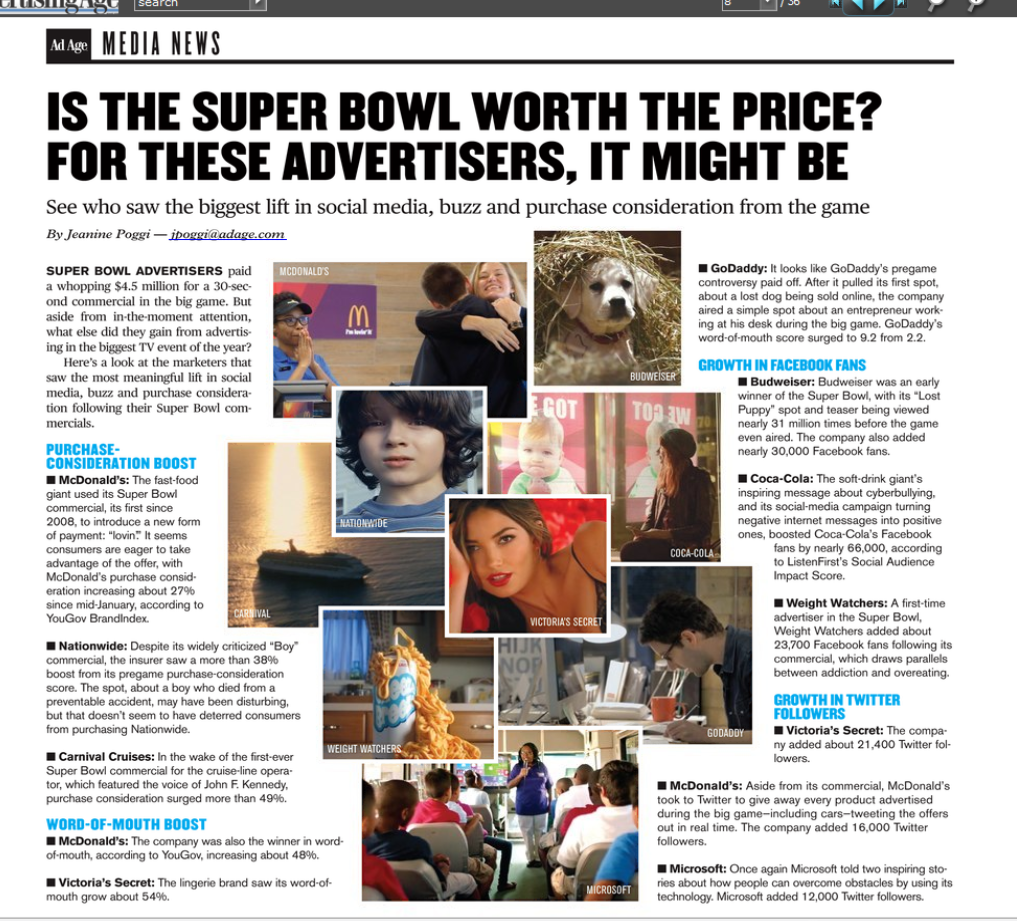
Every year, companies question if advertising on the Super Bowl is worth the $4.5 million it cost in 2015. A brief article in Ad Age highlighted the winners based on purchase consideration boost, word-of-mouth boost, growth in Facebook fans, and growth in Twitter Followers. This blog post examines the fourth category – growth in Twitter followers.

Growth in Twitter followers

  • McDonald’s – In addition to an increase in word-of-mouth buzz of 48%, McDonald’s added 16,000 Twitter followers.
  • Victoria’s Secret – In addition to word-of-mouth increase of 54%, Victoria’s Secret added 21,400 Twitter followers.
  • Microsoft – added 12,000 Twitter followers with the brand’s Super Bowl appearance.

Discussion Questions:

  1. Which of the first three Super Bowls ads did you like the best? Why?
  2. What was your impression of Microsoft’s Super Bowl ad?
  3. How important is it for brands to add Twitter followers with Super Bowl ads? Why?
  4. Of all of the Super Bowl ads, why did these three ads result in large increases in Twitter followers?
  5. Budweiser, Coca-Cola, and Weight Watchers were the winners in adding Facebook fans. Which is better for a brand, adding Facebook fans or Twitter followers? Justify your answer.
  6. Adding Twitter followers is just the first step. Now what must each of the brands do to maintain the interest of these fans following the Super Bowl ad? Be specific.

Here is an image of the Ad Age article from February 9, 2015.

AdAgeSuperBowlFeb915

Super Bowl Winners 2015, Part 3 (Chapters 7 & 9)

Every year, companies question if advertising on the Super Bowl is worth the $4.5 million it cost in 2015. A brief article in Ad Age highlighted the winners based on purchase consideration boost, word-of-mouth boost, growth in Facebook fans, and growth in Twitter Followers. This blog post examines the third category – growth in Facebook fans.

  • Budweiser – This ad was rated number one for the 2015 Super Bowl and the teaser prior to the Super Bowl was viewed 31 million times. The brand added 30,000 new Facebook fans.
  • Coca-Cola – This message about cyberbullying and its social-media campaign resulted in a boost of 66,000 Facebook fans.
  • Weight Watchers – This first-time ever ad for Weight Watchers resulted in 23,700 new Facebook fans.

Discussion Questions

  1. Which of the three Super Bowls ads did you like the best? Why?
  2. How important is it for a brand to add Facebook fans as a result of a Super Bowl ad? Explain why. Give specifics.
  3. Weight Watchers wanted to draw a parallel between addiction and overeating with its ad. Do you think they accomplished this goal? Why or why not?
  4. The goal of the Coca-Cola ad was to turn cyberbulling and negative social media messages into positive ones. Do you think this ad effectively did this? Why or why not?

Here is an image of the Ad Age article from February 9, 2015.

AdAgeSuperBowlFeb915

Super Bowl Winners 2015, Part 2 (Chapters 7, 9, 10)

Every year, companies question if advertising on the Super Bowl is worth the $4.5 million it cost in 2015. A brief article in Ad Age highlighted the winners based on purchase consideration boost, word-of-mouth boost, growth in Facebook fans, and growth in Twitter Followers. This blog post examines the second category – word-of-mouth boost. Word-of-mouth is measured through social media buzz, which is covered in Chapter 9 of the text. The concept of word-of-mouth is also covered in Chapter 10.

Word-of-Mouth Boost

  • McDonald’s – first ad since 2008, increase in word-of-mouth buzz was 48%
  • Victoria’s Secret – word-of-mouth grew by 54%
  • GoDaddy – this ad is the entrepreneur ad that did appear on the Super Bowl. The company’s word-of-mouth surged to 9.2 from 2.2, over a 300% increase.
  • GoDaddy Lost Puppy Ad– this ad was launched prior to the Super Bowl and was pulled because of backlash.

Discussion Questions:

  1. Which of the first three Super Bowls ads did you like the best? Why?
  2. Examine the Super Bowl of GoDaddy’s (Lost Puppy) that was pulled prior to the Super Bowl. This ad generated a considerably amount of negative buzz because it seemed to be about puppy mills. As a result GoDaddy pulled the ad. Do you think pulling this ad had any impact on the surge in word-of-mouth buzz generated by the entrepreneur ad they did have in the Super Bowl? Why or why not?
  3. Explain why you think each of the ads generated a high word-of-mouth buzz score. Be specific.
  4. How important is generating word-of-mouth buzz with a Super Bowl ad? Why?
  5. With GoDaddy, each year the company creates two ads. One is rejected, the other is accepted. Many critics believe GoDaddy does this on purpose to generate buzz knowing people will go to the Internet to see the rejected ad. Do you think the lost puppy ad was done on purpose, to drive buzz for GoDaddy? Why or why not?

Here is an image of the Ad Age article from February 9, 2015.

AdAgeSuperBowlFeb915

Super Bowl Winners 2015, Part 1 (Chapter 7)

Every year, companies question if advertising on the Super Bowl is worth the $4.5 million it cost in 2015. A brief article in Ad Age highlighted the winners based on purchase consideration boost, word-of-mouth boost, growth in Facebook fans, and growth in Twitter Followers. This blog post examines the first category – boost in purchase consideration.

Purchase Consideration Boost

  • McDonald’s – first ad since 2008, increase in purchase consideration of 27%
  • Nationwide – pregame ad was controversial, but sparked a 38% purchase consideration boost
  • Carnival Cruises – first ever Super Bowl ad resulted in more than 49% purchase consideration boost

Discussion Questions:

  1. Which of the three ads did you like the best? Why?
  2. What do you think about the Nationwide ad? Does showing a tragedy create a negative emotion? Why or why not? Why do you think this ad generated a boost in purchase consideration?
  3. The Carnival Cruise ad used the voice of John F. Kennedy. What impact do you think this had on the ad? Who would be the target market for this ad?
  4. Why do you think of all the ads shown on the Super Bowl these three had the highest boost in purchase considerations? Be specific in explaining why.

Here is an image of the Ad Age article from February 9, 2015.

AdAgeSuperBowlFeb915

Social Listening (Chapter 9)

A valuable benefit of social media for brands is the opportunity to gain insights into consumer feelings and thoughts. But, listening can be an overwhelming task if it involves multiple social media platforms and thousands of postings and mentions. This article in Quirk’s Marketing Research Review provides an excellent summary of social listening with ways each method can be used. The article even provides examples of social tools that can be used.

Discussion Questions:

  1. The article begins by stating companies will increase dramatically expenditures on native advertising and content marketing. Why will companies spend more on these two forms of promotion?
  2. Why is listening to social media conversations important?
  3. Think about your university. From the list of six methods explained in the article, identify two that could be used by your university. Explain how the method could be used and what your university could learn.
  4. Identify a restaurant that your patronize regularly. How could the restaurant use social listening to gain customer insights. Be specific.

Technology and the Elderly (Chapter 4)

When we think of technology, we usually think if the young. But, what about seniors, the elderly? How do they react to all of the new technology. I found this article fascinating. The YouTube video may also help students understand the challenges the elderly face with technology.

Discussion Questions:

  1. In terms of designing digital marketing and social media content for the elderly, identify five points from the article that you believe are important. Explain why each is important.
  2. Discuss how your grandparents (or someone else you knows that is 65 or older) handle technology.
  3. Watch the video. What did you learn or was reinforced about seniors and technology?

Budweiser Super Bowl Ads (Chapter 7)

Budweiser created the top ad (according to most rating agencies) for both the 2015 and 2014 Super Bowls. The brand’s 2013 ad also received high ratings.

Discussion Questions:

  1. Watch all four Budweiser ads. Which one did you like the best? Why?
  2. Compare the 2013, 2014, and 2015 ads to the one in 2012. Why do you think Budweiser changed its Super Bowl advertising approach?
  3. In 2014 and 2015 the Budweiser ads were rated at the top by most rating agencies. Is this important for Budweiser? Why or why not?
  4. Most creatives believe emotional ads are the key to developing brand loyalty. Would you agree with this statement? Why or why not?
  5. To produce these Super Bowl ads, Budweiser spends over $5 million per ad (cost of air time and production of ad). Is that a wise use of marketing dollars? Why or why not?

Fear Appeal, Quit Smoking (Chapter 6)

This advertisement was produced in Australia to encourage individuals to quit smoking. It would be excellent to generate a discussion of the fear appeal.

Discussion Questions

  1. What level of fear do you think is displayed in this ad? Explain.
  2. Do you think this ad would have an impact on people who smoke? Why or why not?
  3. Look at the Behavioral Response Model in the chaper. Discuss the concepts of severity and vulnerability as presented in this ad.

Watch this anti-smoking advertisement.

  1. What level of fear do you think is displayed in it? Why?
  2. Compare this ad to the first ad. Which would be more effective? Why?